On a lighter note, one of the funnier moments of the basketball season was Coach Hardy’s music critique of the hip-hop track “Rump Shaker”, by Wreckx N’Effect. The track was typical of hip-hop at the time as it was raunchy, misogynistic, and complete with a music video where women are dancing around a swimming pool shaking around and jiggling their bits. There were a lot of videos of that ilk at the time. We were leaving for a game, and someone happened to bring up the song which had become a big hit. Coach Hardy voiced his disdain for the lyrical quality offered by the group: “What is this?! Shake it around, shake it around, shake it around so I can stick it in?.” We about died laughing. While he wasn’t quoting direct lyrics from the song, he accurately summarized the message of the track in hilarious fashion with his weary delivery.
Oftentimes, we would travel to the games in Coach Hardy’s car. We would commandeer the car radio and surf the dial for tunes. On one occasion we happened upon the familiar synth intro of The Human League’s “Don’t You Want Me”. Danny and I immediately recognized the song and started singing along in our loudest, musically challenged voices. Chetan, who was 15 and clearly had no familiarity or affinity for the New Romantic scene or this song looked at us with confused bewilderment. Me and Danny just sang the chorus louder. In a way, it served as an example of the disconnect that I had with some of the underclassmen. By the way, the fact that Chetan didn’t recognize, “Don’t You Want Me” by The Human League in effect validated my general antipathy toward him. Musical leanings counted for a lot and defined you in some ways. But it was way cooler to be dialed into hip-hop than Human League-type synth-pop in 1992-93.
Chetan was not a fan of The Human League.
Music played a prominent part in my life. 1992 proved to be a great awakening for me from a musical standpoint. Many of my more vibrant recollections from 1992 are connected to music. I regularly wore headphones and listened to music on my way to school. In the early part of the school year, it would be Queen’s greatest hits on my Sony Walkman, or I would be dialed into 107.5 WGCI listening to Doug Banks in the morning. I discovered Queen during my time in Pittsburgh. The band’s lead singer Freddy Mercury had passed away from AIDs in 1991. Afterward, there had been a massive tribute concert in London that was televised by MTV on April 22nd 1992. Rock music’s biggest stars had turned out to perform their renditions of Queen songs at Wembley. I was learning how influential and beloved Queen was as a band on a global level. I particularly recall Annie Lennox and David Bowie singing “Under Pressure”. The emotion that Annie Lennox poured into that performance was moving. She physically and emotionally gave all of herself. As a performance, it made a lasting impression on me. Seal bravely took on, “Who Wants to Live Forever” and I remember him struggling with the higher vocal registers that Freddie Mercury regularly hit. They didn’t make many like Freddy!
Annie Lennox and David Bowie at Wembley.
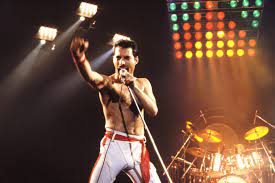
Freddie in one of his iconic poses.
The Freddie Mercury tribute also coincided with the release of the film, “Wayne’s World”. Mike Myers insisted on using the Queen song, “Bohemian Rhapsody” in the film and it was a stroke of creative genius. The song was originally released in October of 1975 and was now being re-introduced to a new audience…….such as myself! “Bohemian Rhapsody” hit #2 on the US Billboard 100 in 1992. I purchased Queen’s greatest hits in the summer of 1992 and was it ever a worthwhile purchase. I played that cassette tape probably well over a hundred times. I love that in the clip from Wayne’s World, they drive along Milwaukee Avenue in Chicago.
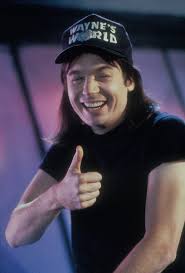
What drew me to Queen’s music were their obvious qualities: Freddie Mercury’s vocals teamed with Brian May’s guitar had such a distinctive sound. The band were oh so obviously British, but the overriding attraction for me was how emotionally charged the music was. Mercury’s vocal delivery and heart on your sleeve, yet never cheesy lyrics were addictively gripping. I would quietly enter the school building absolutely charged to the gills on emotional adrenaline. Funny enough I played “Under Pressure” for Danny and he gave it an immediate thumbs down. I was shocked, offended, and even mortified. I guess for Danny, Queen couldn’t hold a candle to The New Kids on the Block, Bad Boys Blue, or Paula Abdul.
Mainstream pop music was in an interesting place come the fall of 1992. The soundtrack to my senior year was varied, unusual, and full of energy. What I was listening to flirted with the mainstream but also dug into more niche genres that had grown in popularity. Particularly the house and techno tracks that were pumped out regularly on Chicago radio during the early 90’s. Most of the music came from late-night playlists or mixes on B96. Julian “Jumpin” Perez, “Bad Boy” Bill, and Tim “Spinnin” Schommer were a few of the prominent DJs at the time. This was also the era when Energy 88.7 was at its zenith. Energy 88.7 was a college radio station run by students from Loyola University in Chicago’s Rogers Park. My most vivid music memories of 1992-1993 are connected to Energy 88.7. On Friday and Saturday nights, the Energy 88.7 Powerpack would be unleashed on the sound waves of the city. DJ’s like Brian Clarke, Jammin’ Down JD, and others would play their mixes.
What made Energy 88.7 unique and memorable was that it was an independent radio station. The DJ’s were playing whatever music they wanted. The station’s signal wasn’t very strong, so you were always trying to fix your dial just right or adjust the antenna to pick up the best reception. Their playlist was a rich mix of House, New Wave, Techno, Italo-Disco, and tracks from Europe that were not part of the mainstream. DJ Markski soon was added to the lineup and became extremely popular as he started playing sets that were exclusively devoted to Eurodance. What was Eurodance? It started with bands like Blackbox and Snap! They were concepts put together by European producers who would hire American singers and rappers to record catchy, repetitive electronic pop songs driven by futuristic, analog keyboard riffs and BPM (beats per minute) of at least 120. The genre was exploding by 1992 with artists like Dr. Alban from Sweden, Snap! The Captain Hollywood Project, and so many others. DJ Markski happened upon what would become a global phenomenon.
Fall of 1992 represented one of the best eras of electronic dance music ever. Music can cue up very particular images, and memories of people. Whenever I hear “Outer Space” by The Prodigy I think of Javier, his affinity for the song, and the mini dance he would break into. The slow languid, Jamaican patois chorus giving way to the frenzied, goofy, helium voice raver informing you that, “I’ll take your brains to another dimension, pay close attention!” perfectly epitomized the likable, comic, offbeat quirky character of Javier.
Aside from Eurodance, there was also Euro disco. This genre was more of a mixed bag and contained some cheesy, cringe-inducing efforts along with undeniably catchy tunes. Bad Boys Blue being one of the mainstays from the era and a perfect example of the musical dichotomy. Danny loved him some Bad Boys Blue and they brought serious cheese to the table. Yet, I’ll admit it. I liked some of their songs as well, but Danny was the biggest fan. Looking back Danny had a rather dubious list of bands that he loved: Milli Vanilli, New Kids on the Block, and Bad Boys Blue to name a few. Maybe Danny had better taste than I’m giving him credit for, but there were some real howlers in there as well. I’m going to look into a Bad Boys Blue 2023 reunion tour for Danny.
Coming back to Energy 88.7, another element that made the station memorable was how unpolished and raw the DJs were. The commercial radio stations such as B96, had hosts that were well-trained, professional, and on point. The Energy 88.7 crew would regularly stumble over words, have awkward pauses, and lacked the same kind of verbal fluidity of their commercial neighbors further up the dial. It must be pointed out that Energy 88.7 did have a great voiceover who introduced “The Power Pack on 88.7”. He was almost certainly a middle-aged man, but he absolutely nailed it. The listening audience knew the goods would be delivered when they heard his voice.
Energy 88.7 also captured some of the magic of the Medusa nightclub era. Aside from the heavy Eurodance influence, the DJs playlists would expose the audience to music rarely if ever played on mainstream radio. To be clear, we’re not talking about what Americans associate with “College Radio”, which immediately brings to mind acoustic, grassroots, alternative bands with stripped-down production. The music on 88.7 was all electronic and bore far more in common with playlists you might hear in London, Berlin, or Milan. Senior year may not have been as memorable as 8th grade in most respects, but the music was incredible.
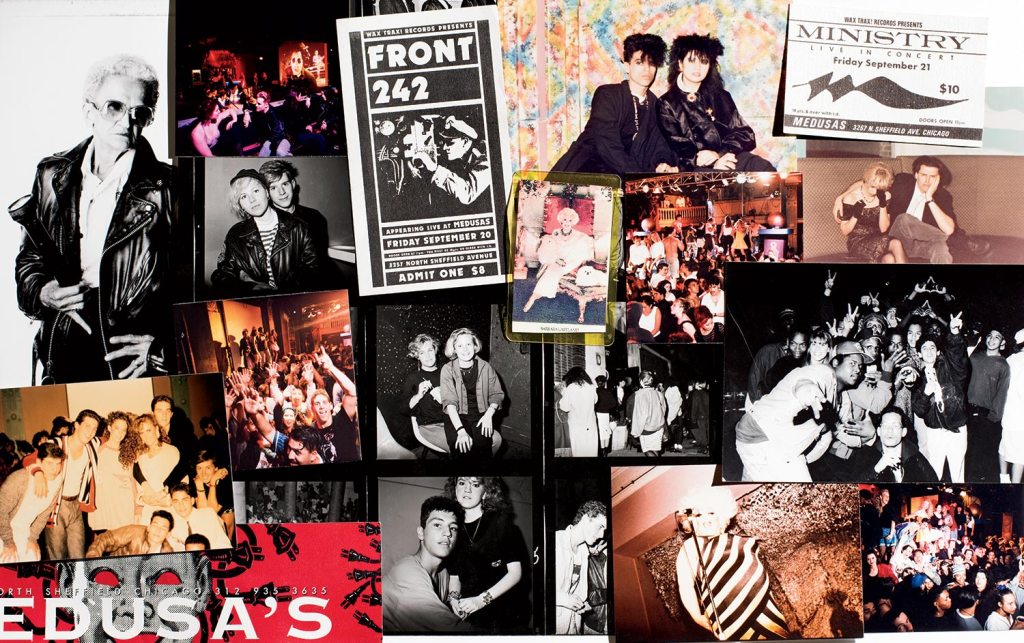
A snapshot of Medusa’s on Sheffield Avenue.
Of course, there was a lot more going on in music aside from 88.7 and the late-night mixes on B96. Mainstream music had a prominent place amongst the students. This was reflected at lunchtime when many of us would head over to the Burger King on California and Irving. There was a jukebox at the BK, and it would be a competition to see who could load the songs they wanted first. The girls would almost always play Jon Secada or a Whitney Houston song from The Bodyguard soundtrack. The two songs that I regularly lined up on the jukebox were “No Ordinary Love” by Sade and “Love to Hate You” by Erasure. Funny enough in college I dived into the music catalog of both groups. By the way, Sade is in fact a band, not just the female singer.
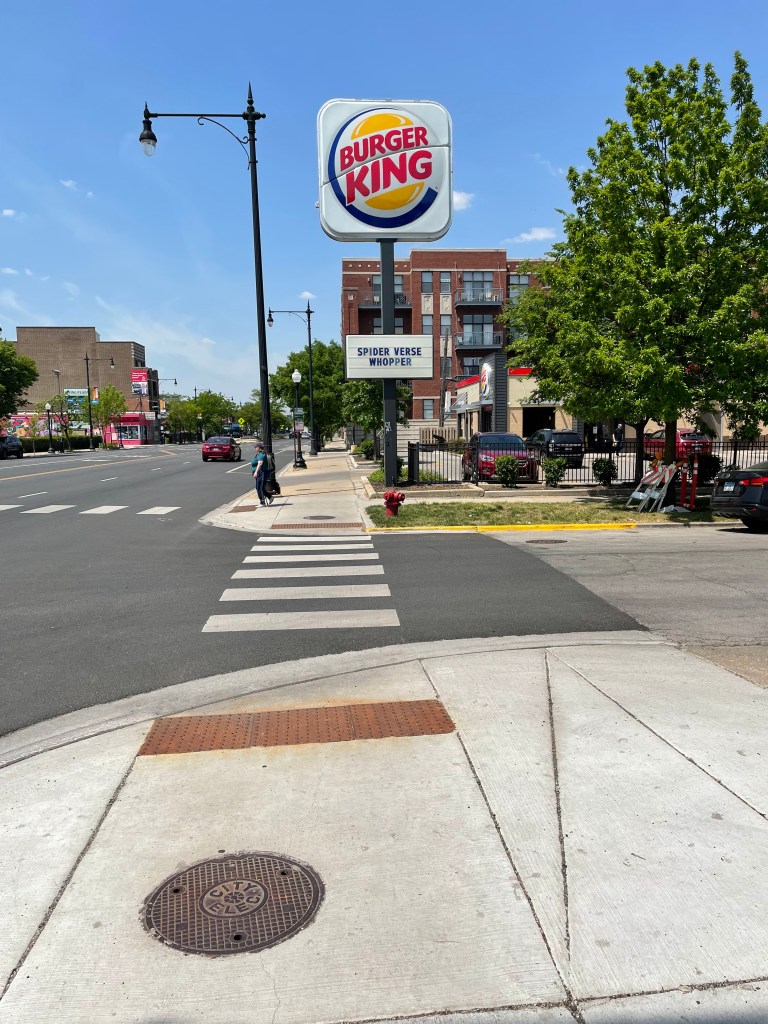
The jukebox was the feature attraction at the Burger King on Irving Park Rd near California..
Going to school in the morning I would ride the bus with my Walkman tuned to 107.5 WGCI. This was a strict departure from 88.7 and B96 as GCI was primarily marketed to a Black audience. The song rotation on GCI was okay. There was a lot of Jodeci, Mary J Blidge, and plenty of rap. The only rap single that I bought senior year was “I Gotta Man” by Positive K. Revisiting the track, it is easy to hear its appeal. The sample used and the delivery bears more similarity to a late 80’s sound than the early 90’s. I had been drifting away from rap as the 90’s progressed. There was still some material I liked but more and more often I was having to sift through a lot of tripe to find it. From my point of view, rap had become a lot more aggressive and was losing some of its magic for me.
There were some gems, depending on your standards. “Clean-Up Man” by Willie D. a rap track that will not go down in the annals of hip-hop history, but it sticks in my mind for its appalling ridiculousness: The video featured regularly on this newly created TV station called JukeBox. Willie D was a member of The Geto Boys. “Clean-up Man” was the first single from his solo album. “Clean-up Man” tells the tale of a man (Wille D) who swoops in and takes your woman if you’re not taking care of her. Since I had no woman for Wille to take, I was safe from Willie’s game for the time being. The video takes place around a pool as Willie struts around eyeing up his female targets. At the same time, a pudgy singer fully committed to his excitable, yet awkwardly hilarious dance routine extols Willie’s woman-seducing charms. We how led with laughter so hard at this foolishness.
However, for me the best part of mornings on 107.5 was listening to their morning DJ. Doug Banks was a big black guy with a voice that didn’t match the outside packaging at all. His vocal intonation was slightly higher and not a deep traditional DJ’s voice. It mattered little because Doug Banks just had “It”, whatever that intangible quality is that brings a radio personality to life. He was funny, quick-witted, very human, and decent. Doug’s conversations with callers, his reading of entertainment news, or commercial sponsors were fantastic. His vocal inflections were perfectly timed, and I can still hear him pitching insurance for “Arco American!”. Doug Banks was a true original and without a doubt my favorite radio DJ ever. It was so sad that he passed away at the relatively young age of 57 in 2016. Doug Banks was a Chicago radio legend.
Doug Banks in the Chicago Bears sweater hamming it up with Tom Joyner
There were some genres of music that never had any presence at Gospel Outreach. Alternative rock was huge nationally but non-existent for all intents and purposes within the music culture at Gospel Outreach. That may sound shocking but this was a small pool of primarily Hispanic teens in 1992. As for myself, I liked Nirvana’s songs, but I wasn’t going to seek out music that was fundamentally depressed, joyless, and limited to a couple of guitar chords.
 Gospel Outreach School and High School Memories 1988-1992